Salt Season Survival Guide: Protect Driveways, Pavers, Railings, and Landscaping
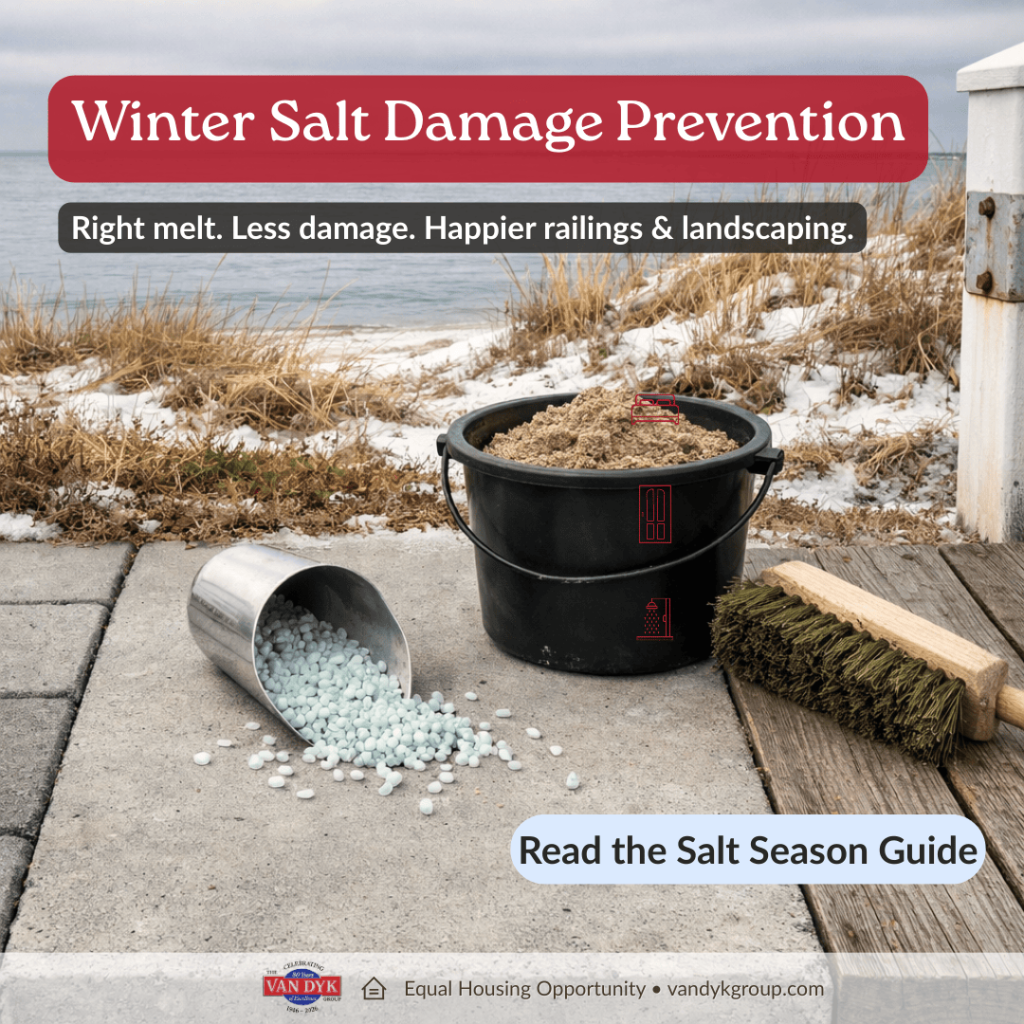
If you own a home on Long Beach Island or in the surrounding towns, late winter (hello, February) is prime time for salt and de-icer fallout. Between road salt, freeze–thaw, and “just one more sprinkle,” damage gets baked in quietly… like a bad decision. The good news: winter salt damage prevention is mostly about choosing the right melt, using less, and doing a rinse-and-reset before spring shows you the receipts.
Pick the right melt for the surface (and what to avoid)
The #1 rule is boring but undefeated: remove snow first. De-icers should help you break the bond and clear what’s left—not melt everything down to bare pavement.
-
Poured or stamped concrete: Concrete groups warn that aggressive salts can increase surface scaling, especially on newer concrete or concrete that stays wet during freeze–thaw. Use the smallest amount needed, avoid piles, and choose sand for traction when temps are very low.
-
Concrete pavers: Pavers are durable, but joint sand and adjacent beds aren’t. Apply lightly, keep product out of joints when possible, and sweep up excess once the ice loosens.
-
Wood or composite decks: Skip harsh salts. They can leave residue, dry out wood, and speed up corrosion on screws/connectors. Use a product labeled for decks or stick with sand.
Coastal extra credit: stop corrosion where it starts
On-island and bayfront homes get the double whammy: de-icer plus salt spray. Corrosion usually begins at the “quiet spots”—fastener heads, railing base plates, stair brackets, gate latches, and anywhere two different metals touch. For coastal winter salt damage prevention:
-
Rinse railings and hardware with fresh water when temperatures are safely above freezing.
-
Watch for rust blooms, bubbling paint, or white powdery oxidation, then touch up early.
-
When replacing parts, choose corrosion-resistant hardware designed for coastal exposure.
Pet and plant safety: what matters vs. marketing fluff
“Pet-friendly” doesn’t mean “safe to ingest,” and “plant-safe” can still burn foliage if overapplied. For winter salt damage prevention, smarter application beats “stronger” product:
-
Sprinkle, don’t pour. Treat only the zones you actually use.
-
Let it work, then shovel again. Leaving salty slush to “melt itself” is how landscaping gets hit.
-
Wipe paws after walks; rinse and dry feet if your pet licks them clean.
-
Keep shoveled piles off shrubs and lawn edges to limit salt build-up in soil.
Late-winter rinse + reset plan
Pick a day above freezing—ideally around 40°F—so water won’t refreeze.
-
Hose-rinse driveways, pavers, steps, and the lower portion of railings to flush residue.
-
Spot-check concrete for flaking/soft areas and pavers for shifting or joint loss.
-
Plan sealing or joint-sand touch-ups for a dry stretch in early spring. This is winter salt damage prevention that pays you back.
Thinking about a bigger exterior refresh later this year—new pavers, railings, a driveway redo, or just “make it look less tired”? We can point you to what tends to hold value best locally. Contact us: https://www.vandykgroup.com/contact-us/#
Sources & References
- Purdue Extension — “Deicer’s Impact on Your Landscape” (Jan 21, 2025) — https://extension.purdue.edu/news/county/putnam/2025/01/deicers-impact-on-your-landscape.html
- The Ohio State University Extension — “Using De-icers this Winter” (Jan 24, 2025) — https://u.osu.edu/lorainanr/2025/01/24/using-de-icers-this-winter/
- University of Wisconsin School of Veterinary Medicine — “Protect Your Pets from Winter Hazards” (Jan 17, 2024) — https://www.vetmed.wisc.edu/protect-your-pets-from-winter-hazards/
- Michigan Concrete Association — “Preventing Scaling of Concrete…” (Jul 1, 2024) — https://www.miconcrete.org/hubfs/MCA%20Scaling%20Tech%20Bulletin%2007012024%20%28Type%20IL-PLC%29%20REV%2008192034.pdf?hsLang=en
- U.S. Geological Survey — “Regional high-frequency monitoring… chloride… Delaware River Basin” (Aug 29, 2025) — https://www.usgs.gov/publications/regional-high-frequency-monitoring-revealed-chloride-concentrations-exceedance
Last Updated on February 19, 2026