Condo & Townhome Buyers: The February HOA Document Deep-Dive (Before You Write an Offer)
If you’re buying a condo or townhome in the Long Beach Island (LBI) Region, the February HOA document checklist is your unfair advantage. Why? Early-year budgets and insurance summaries are typically fresh, year-end financials are easier to track down, and you can review everything before spring competition turns every decision into a caffeine-fueled sprint.
Here’s the reality: the unit might be perfect, but the HOA paperwork can quietly make it expensive, restrictive, or harder to finance. Let’s reduce risk before you fall in love with the view.
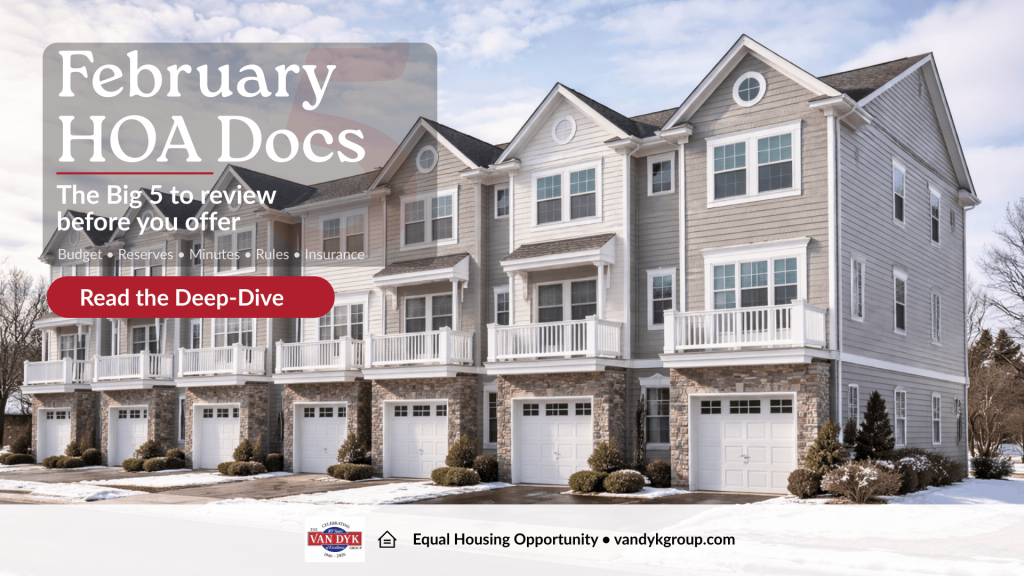
The Big 5 Documents to Request (and what to scan for)
Ask your agent/attorney for these before you write (or at least before you remove contingencies):
-
Current-year budget + year-end financials
Look for realistic line items (utilities, management, maintenance) and whether dues are keeping up with rising costs.
-
Reserve study + current reserve balance
A reserve study is a long-term planning tool that maps out major components the association maintains (roof, siding, paving, etc.) and recommends a funding plan. Translation: it predicts big future bills—so you’re not “surprised” later.
-
Recent meeting minutes (12–24 months)
Minutes are where the truth shows up: roof quotes, drainage issues, recurring leaks, elevator repairs, ongoing contractor disputes.
-
Rules, regulations, and rental policies
Don’t assume you can rent short-term, have certain pets, park work vehicles, or install an EV charger. Verify it in writing.
-
Insurance summary (master policy overview)
You want to know what’s covered (and what isn’t), deductibles, and whether coverage limits look appropriate for replacement costs—because gaps can become special assessments fast.
Red Flags Buyers Miss (until it’s expensive)
These are the usual suspects:
-
Special assessments (current or “we’re discussing one”)
-
Low reserves relative to building age and major components
-
Deferred maintenance (especially structural, exterior envelope, drainage)
-
Insurance gaps or very high deductibles
-
Rental restrictions that kill your Plan B (or your financing options)
Some lenders and loan programs scrutinize condo projects for issues like critical repairs, significant deferred maintenance, and special assessments—because they can create unsafe conditions and real financial hardship for owners.
Coastal vs. Inland: what changes in the LBI Region
In coastal communities, HOA docs often reveal higher exposure to:
-
Exterior wear (salt air, wind-driven rain, corrosion)
-
Shared systems (roofs, siding, stairwells, elevators, parking areas)
-
Storm-related maintenance planning and budgeting
Also, don’t treat flood risk like a “maybe.” Standard homeowners insurance typically doesn’t cover flood damage, and condo communities may carry separate flood coverage depending on location and building type. As you review the HOA’s master policy, it’s smart to confirm what’s covered, what isn’t, and what owners are expected to carry individually—your agent and attorney can help, and our team can also walk you through the insurance side (master policy + unit coverage + flood options) so there are no ugly surprises after closing. Learn more here: https://www.vandykgroup.com/personalinsurance/
The Buyer “Ask List” (so nothing gets glossed over)
Hand this to your agent/attorney and keep a straight face while you ask for it:
-
Current budget + last year’s financials + delinquency rate
-
Reserve study date + reserve balance + any planned major projects
-
All special assessments (past 2 years and proposed)
-
Minutes for 12–24 months (not just the “nice” ones)
-
Rules on rentals, pets, parking, renovations, storage, and amenities
-
Master insurance summary + deductibles + any recent claims/loss history
-
Who maintains what (interior vs. windows vs. balconies vs. exterior)
-
Any known litigation or code/inspection issues
Why February is the smart month to do this
February is the sweet spot: documents are typically current, boards have clearer budget direction, and you can negotiate (or walk away) while you still have options. Spring buyers tend to skip steps. You don’t need to be one of them.
If condos or townhomes are your target in the LBI Region, you can narrow your options fast using our search filters here: https://www.vandykgroup.com/realestatevacation/search-homes-an-properties/#. And if you want a second set of eyes on HOA docs before you commit, reach out here: https://www.vandykgroup.com/contact-us/#.
Source References
- Fannie Mae — Selling Guide Announcement (SEL-2023-06), July 5, 2023 (condo project eligibility, critical repairs, special assessments): https://singlefamily.fanniemae.com/media/36376/display
- Fannie Mae — Selling Guide: Project Standards (B4-2) (ongoing condo project standards guidance): https://selling-guide.fanniemae.com/sel/b4-2/project-standards
- Community Associations Institute (CAI) — Reserve Studies & Funding Resources (June 2025): https://www.caionline.org/getmedia/a36f9c9a-34d4-4c72-afd7-24cdaa5e19e5/ReserveStudyResourcesJune2025_1.pdf
- CAI — Chart of State Laws: Condominium Reserves (June 2025) (high-level state-by-state reserve considerations): https://www.caionline.org/getmedia/81e21e40-05bb-43af-aa3a-6a33d18b8975/Chart-of-state-laws-Condominium-reserves-JUNE2025.pdf
- FEMA / NFIP — Flood Insurance for Condominium Associations (Jan 2025 brochure) (condo association flood coverage overview): https://agents.floodsmart.gov/sites/default/files/media/document/2025-07/fema-nfip-flood-insurance-condominium-associations-brochure-01-2025.pdf
Last Updated on February 26, 2026